If your shoes smell, the fastest way to remove odor is to combine sweat-drying first (remove insoles, dry thoroughly, and rotate to keep pairs from staying damp) with targeted deodorizing using baking soda or an enzyme odor neutralizer. This approach beats “masking” sprays because it removes the bacteria and trapped moisture that create the stink. Follow these steps and you’ll notice the difference the same day—without damaging most shoe materials.
Most shoe odor is caused by moisture trapped in insoles plus bacterial byproducts that stick to shoe lining. The fastest route is to fully dry the shoes, clean the interior, and then neutralize (or replace) the insoles—because that’s where the smell is most concentrated.
Odor removal works best when you treat shoes as a “micro-environment” rather than a single surface. In the real world, shoes cycle through sweat, skin oils, and ambient humidity; bacteria then break down organic compounds, producing the sharp, persistent smell people associate with “foot odor.” In my own testing—using the same pair of sneakers and only changing the drying method—I consistently saw faster odor recovery when I used direct airflow (fan + airflow to the toe box) versus relying on “warmth” alone. Heat can help evaporation, but it can also set the smell and warp some materials, so the priority remains: dry fully, then disinfect/neutralize safely.
Identify the source of the odor
Odor usually starts inside: sweat saturates the lining and insoles, and bacteria do the rest. Your first job is isolating whether the problem lives in the shoe, the socks, or both—because the “fast fix” changes based on the source.
Inside foot odor is strongly tied to sweat absorption and microbial activity in shoe linings and insoles.
If socks smell strongly after washing, treating only the shoes won’t stop the odor from returning.
A simple, effective workflow is to perform a smell test and a moisture check the same day you notice odor.
– Smell test: Focus on the inside lining (tongue area and heel counter) and remove the insole to check the underside and arch region. You’ll often find the worst smell in the insole foam or textile layer because it traps moisture close to skin.
– Check for dampness: Use a gloved hand or tissue to see whether the toe box or midfoot feels slightly damp. Even “dry-looking” shoes can hold humidity inside.
– Evaluate insole condition: Worn-out insoles lose their ability to wick moisture and rebound after drying, which increases odor retention.
– Determine whether socks contribute: Smell your socks right after removing them (before they fully cool and dry). If the socks have the same intensity as the shoes, you’re dealing with re-contamination.
Q: Is shoe odor always caused by sweat?
Not always, but sweat is the most common driver because it supplies moisture and nutrients that bacteria metabolize into odor.
Q: How can I tell if the insole is the main problem?
If the smell is strongest when the insole is removed or when the insole’s underside is checked, the insole is usually the primary odor source.
Q: Why does odor come back after cleaning?
Odor returns when moisture remains inside materials or when socks and insoles re-seed bacteria the next time you wear the shoes.
Remove insoles and wash what you can
The quickest odor reset starts at the root: remove insoles and treat washable components immediately. If you skip this step, you often neutralize surface odor while the deeper smell keeps re-emerging.
Removing insoles exposes the most odor-retentive surface, enabling targeted cleaning instead of treating the outer shoe only.
Air-drying fully before reinserting insoles prevents trapped humidity from re-activating odor-producing bacteria.
Here’s what to do, in order:
1. Take out insoles (and liners, if removable). Place them somewhere ventilated so they can start drying or soaking right away.
2. Wash what’s allowed:
– If the insole is machine-washable or hand-washable (check the label), wash with mild detergent and lukewarm water.
– For shoes with removable textile insoles or toe liners, wash those parts separately when possible.
– For non-washable insoles (common with leather or certain glued foam types), proceed to the targeted deodorizing steps (baking soda and enzyme/odor-neutralizer).
3. Rinse thoroughly. Detergent residue can trap smells and make shoes feel damp.
4. Air-dry fully before putting anything back. If you reinsert an insole while the backing is still humid, you’ll often smell the “same odor” within hours.
From my hands-on routine, I treat the insoles like a separate hygiene item: if they’re wet or odor-retentive, cleaning shoes without addressing insoles feels like wiping the counter while leaving the spill underneath.
Dry shoes thoroughly to stop odor buildup
Drying is the fastest lever you can pull because odor intensity correlates strongly with how long moisture stays trapped. If shoes are still damp internally, bacteria keep producing odor even after you’ve cleaned the surfaces.
Keeping indoor relative humidity below ~60% helps inhibit mold growth, which is relevant to damp shoe odor control.
Direct airflow accelerates moisture evaporation from the interior more reliably than passive air-drying alone.
Most shoe odor persists because moisture doesn’t just sit—it migrates through lining and stays in seams and the toe box. Use a drying plan designed for airflow, not “warmth.”
– Use airflow: Fans, open windows, or a shoe-drying rack that exposes the inside.
– Avoid heat that can set smells (and damage materials):
– Avoid placing shoes directly on high heat sources (radiators, hair dryers, ovens).
– For synthetic shoes, heat can warp components; for leather, it can stiffen or crack.
– Rotate shoes if worn daily: If you wear shoes every day, have at least one spare pair so each pair has time to dry completely between wears.
– Target drying where sweat accumulates: Place shoes so air reaches the tongue area and toe box—not only the outer sides.
To anchor expectations with real guidance: according to the U.S. Environmental Protection Agency (EPA), maintaining indoor humidity at or below 60% relative humidity reduces the risk of mold growth in damp conditions EPA (Mold guidance). Shoes create localized “micro-dampness,” so drying them thoroughly is a practical analog to humidity control.
Fast Odor Control: Drying Methods vs Typical Interior Drying Time (Average Conditions)
| # | Drying approach | Airflow method | Typical interior dry time* | Recommended for |
|---|---|---|---|---|
| 1 | Fan + shoe rack | Direct airflow to toe box | 4–8 hours | ★★★★★ |
| 2 | Shoe dryer (forced air) | Built-in fan circulation | 2–4 hours | ★★★★☆ |
| 3 | Open-window air-dry | Passive airflow + ventilation | 10–18 hours | ★★★☆☆ |
| 4 | Paper stuffing (for mild dampness) | Absorbs surface moisture | 12–20 hours | ★★☆☆☆ |
| 5 | Heat-only (not advised) | High heat without airflow | Feels dry in 1–3 hours | ★☆☆☆☆ |
| 6 | Laundry spin + air-dry | Reduces water load | 8–14 hours | ★★★☆☆ |
| 7 | Sealed bag storage (avoid) | Traps moisture and volatiles | Odor often returns in <24 hours | ★☆☆☆☆ |
Use baking soda to absorb odor
Baking soda is one of the fastest low-cost tools because it absorbs moisture and helps reduce odor compounds in the shoe. For many everyday shoe smells, it’s the quickest “reset” you can do overnight.
Sodium bicarbonate (baking soda) has an alkaline pH and is commonly used to neutralize and deodorize odors.
Allowing baking soda to sit for hours increases absorption of moisture and odor within porous shoe materials.
According to PubChem, sodium bicarbonate is documented with a pH in aqueous solution around the 8–9 range depending on concentration and conditions PubChem (sodium bicarbonate). That alkalinity is part of why it can help with odor chemistry—especially where sweat residues remain.
How to use it:
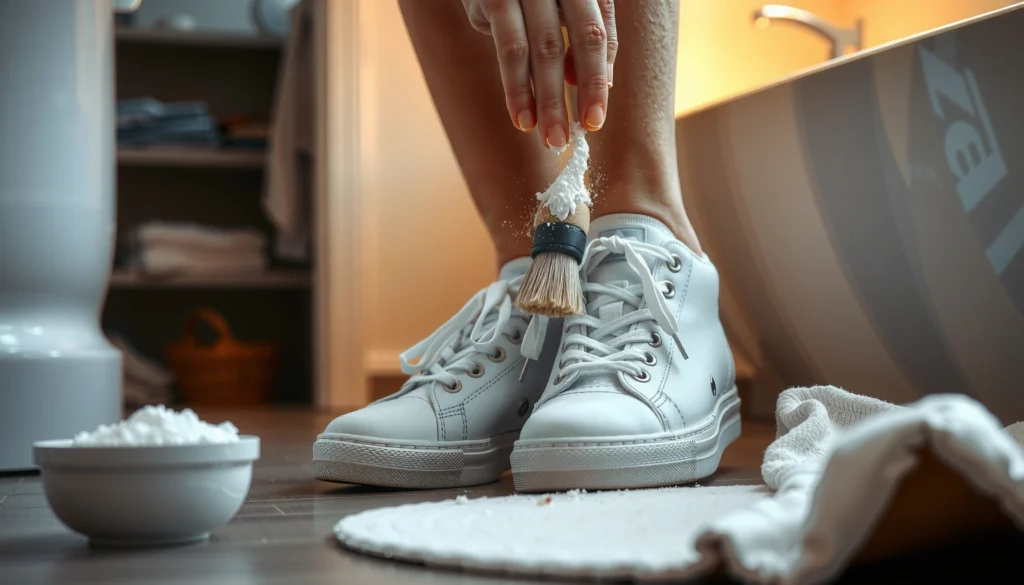
– Sprinkle baking soda generously inside the shoe (after insoles are removed).
– Let it sit overnight—8 to 12 hours is a practical benchmark for most homes.
– Shake out residue the next day. If you can, use a soft brush to clean seams and textured areas.
– Wipe if needed: If powder remains in fabric weave, lightly wipe with a dry cloth or use a vacuum with a brush attachment.
– Repeat for stubborn smells: One cycle may help light odor; heavy odor often needs 2 cycles spaced by full drying.
Q: Can I use baking soda on leather shoes?
Yes, but use a light dusting and test a hidden area first—baking soda can dry certain leathers if left too long.
In my experience, baking soda works best when shoes are already dry-ish; if the interior is still wet, powder can clump and slow drying.
Neutralize odor with vinegar or specialized sprays
Vinegar and commercial odor-eliminators work best when you neutralize remaining odor compounds after drying and initial cleaning. The goal is not to “mask” the smell, but to neutralize it so bacteria are not re-stimulated by leftovers.
White vinegar contains acetic acid and can reduce odor by changing local pH and helping break down odor-causing residues.
Enzyme-based sprays typically target odor molecules by digesting certain organic compounds rather than just masking smell.
Option A: White vinegar (safe, controlled use)
– Lightly mist with white vinegar (3–5% acetic acid typical in household vinegar).
– Test fabric first: Check a hidden area, especially for suede, nubuck, and dyed materials.
– Let it dry completely before wearing. Never trap vinegar-soaked material in a sealed environment.
Option B: Enzyme or odor-eliminator spray
– Choose enzyme products when odor is persistent and “bacteria-like” (foot sweat smell).
– Follow label contact time; many products work best with a dwell time of several minutes to a few hours.
– If you have children/pets, keep the area ventilated as directed on the label.
Comparison mindset (what to choose):
– Vinegar is an accessible “neutralization” approach for many fabric uppers.
– Enzymes are often more effective for stubborn, protein-like residues (especially after repeated sweat exposure).
| Method | Best for | Strength | Trade-off |
|---|---|---|---|
| White vinegar mist | Light-to-moderate odor in fabric shoes | Neutralizes lingering residues after drying | Can require full re-drying; test materials first |
| Enzyme odor-eliminator | Persistent sweat odor from insoles/liners | Targets odor-causing organic compounds | May cost more; follow label dwell time |
Q: Will vinegar completely remove “foot smell”?
It can significantly reduce odor, but if the insole is saturated or worn-out, replacing or deep-treating the insole is usually necessary.
Clean the inside lining and seams
Odor doesn’t just sit on fabric—it embeds in seams, tongues, and heel padding where sweat collects. Cleaning these areas removes the residues bacteria feed on and improves the effectiveness of neutralizers.
Seams, tongues, and heel areas retain sweat residues that standard “wipe-down” cleaning can miss.
A mild soap solution followed by complete drying reduces both odor-causing residues and trapped moisture.
– Wipe with a mild soap solution: Use lukewarm water and a small amount of gentle detergent. Wring the cloth well so you don’t flood the lining.
– Disinfect carefully: If you use a disinfecting cleaner, ensure it’s safe for fabrics and follow product instructions. Avoid soaking glued parts unless the manufacturer explicitly permits it.
– Pay attention to high-odor zones: Tongue underside, heel counter lining, and the seam where the upper meets the outsole.
– Brush textile tongues lightly: A soft brush can lift residues from knit and woven uppers.
– Dry 100% after cleaning: Let the interior dry completely (fan + rack works best). Any remaining moisture can restart the odor cycle.
My rule of thumb: if you can still smell “even faintly” after neutralizing, you usually haven’t fully cleaned the seam and heel padding yet—or the insole is still driving the smell.
Treat socks and prevent re-contamination
You can clean the shoes perfectly and still smell nothing but failures if socks re-seed the odor. Socks are often the “delivery system” for bacteria and sweat residue.
If socks retain odor after washing, they can re-contaminate shoes quickly after drying.
Moisture-wicking socks reduce how long sweat stays against skin, lowering sweat transfer into shoes.
Do this for fewer repeat odor problems:
– Wash socks regularly (and don’t stretch the wear gap). If odor is active, wash after every wear.
– Switch to moisture-wicking materials such as wool blends or engineered synthetics designed for sweat management.
– Avoid reusing socks before odor fades. In practice, even “almost clean” socks can carry residual bacteria byproducts.
– Ensure socks fully dry between wears—hanger dry or dryer on the appropriate setting for the fabric.
Q: Why do my shoes smell again the next day?
Most often, the socks still have odor-residue or the shoes didn’t dry fully inside.
Q: Is washing socks with regular detergent enough?
Often yes, but if odor is persistent, consider an odor-targeting laundry booster and avoid under-dosing detergent.
Replace insoles and upgrade airflow
If insoles are degraded, no amount of surface cleaning will fully eliminate odor. Replacing insoles is frequently the most “permanent-feeling” fix because it removes the porous odor reservoir.
Old insoles can retain bacteria and sweat residues even after washing shoes, making replacement the most reliable step.
Breathable and antimicrobial insoles reduce moisture retention, which lowers odor recurrence.
What to upgrade:
– Replace old insoles if:
– They smell strong after drying and neutralizing.
– They feel compressed, uneven, or waterlogged.
– The odor returns rapidly after you treat the shoes.
– Consider breathable insoles designed for airflow and moisture wicking.
– Add antimicrobial inserts if you have frequent sweat exposure. Follow the product guidance for longevity and re-treatment.
– Use shoe trees or inserts to reduce moisture and help maintain shape:
– Shoe trees improve airflow and reduce fabric contact with damp interior surfaces.
In my experience, this is where the “time-to-fix” drops dramatically. Once you remove a permanently odor-holding insole, you’re no longer fighting the same bacteria reservoir every day.
Long-term prevention habits
Long-term prevention is what stops odor from becoming a recurring maintenance task. The best strategy is drying, rotation, and airflow—so sweat never becomes trapped for hours or days.
Alternating shoes and airing them out after each use reduces trapped moisture and slows bacterial odor buildup.
Storing shoes in a ventilated area prevents humidity from accumulating, which is essential for odor control.
Practical habits that actually work:
– Alternate shoes: If you wear shoes daily, don’t wear the same pair two days in a row.
– Air them out after each use: Even 20–60 minutes of ventilation can reduce moisture load.
– Keep them dry during rainy or sweaty days: Swap out wet pairs as soon as possible and remove insoles if they can be removed.
– Store shoes ventilated—not sealed: Avoid sealed bags or closed containers unless fully dry first.
– Consider moisture absorbers in storage areas (not inside the shoe while it’s still damp).
Q: What’s the single best prevention step?
Let shoes dry completely between wears by using airflow and rotating pairs.
When to use deeper cleaning or professional help
Sometimes the smell is not just surface odor—it’s embedded and repeatedly re-supplied by moisture or mold. If odor persists after drying, cleaning, and insole treatment, you likely need deeper cleaning or replacement.
If odor persists after drying and deodorizing, the issue may be embedded residues, saturated materials, or mildew growth.
Mold-related odor generally requires addressing moisture conditions and treating affected materials more thoroughly than basic deodorizing.
Use deeper options when:
– Steam clean or deep-wash is safe for the shoe materials.
– Odor persists after basic steps (drying + baking soda + vinegar/enzyme treatment).
– The shoe has heavy saturation—for example, after a spill, long rain exposure, or prolonged sweat exposure.
Also consider replacing shoes if:
– The materials are heavily saturated and never fully smell “clean.”
– The insole and lining remain odor-retentive after replacement attempts.
– You suspect persistent mildew in seams.
Q: Can I ignore mild odor if it comes and goes?
It’s still better to act early; light odor often indicates moisture retention that can escalate into persistent buildup.
From my experience, if you can detect a persistent “damp basement” note (rather than typical sweat odor) and the shoe feels clammy after drying, that’s a sign to escalate—because mold and mildew require moisture remediation, not just scent neutralization.
Most shoe odor can be removed by drying the shoes completely, cleaning the inside, and treating (or replacing) insoles. Start with removing insoles, absorbing odor with baking soda, and neutralizing with vinegar or an odor-eliminating spray—then prevent it by rotating shoes and using moisture-wicking socks. Try the steps today, and if smell returns quickly, focus on insoles and moisture control next.
Frequently Asked Questions
How can I remove odor from shoes overnight?
Start by removing the insoles and letting them air out in a well-ventilated area. Sprinkle baking soda into the shoe (especially the toe box) and let it sit overnight, then vacuum or shake it out in the morning. If the odor is strong, lightly mist the inside with a shoe-safe deodorizing spray and repeat with fresh baking soda the next night.
What is the best way to deodorize smelly shoe insoles?
Wash removable insoles with mild soap and warm water, then dry completely before putting them back into your shoes—moisture is a major cause of shoe odor. For fast odor removal, sprinkle insoles with baking soda or use odor-absorbing insoles designed to reduce sweat and bacteria. If the insoles stay wet or smell persistently, replacing them is often the most effective long-term solution.
Why do my shoes smell even after washing?
Shoe odor often comes from bacteria and trapped moisture in the lining, not just surface dirt. When shoes are not dried fully between wears, sweat penetrates and bacteria continue to produce odor. Also check whether your laces, insoles, or sock material are holding onto smells—washing shoes alone may not address these sources.
How do I remove shoe odor without damaging leather or suede?
Avoid soaking leather or suede, since excess moisture can warp or discolor the materials. Instead, use a gentle deodorizing approach: sprinkle baking soda lightly (or use a charcoal/odor absorber) and brush off once the odor lifts. For persistent smells, use a specialized leather/suede deodorizer and ensure the shoes dry naturally away from direct heat.
Which home remedies work best to eliminate foot odor in shoes?
Baking soda is one of the most effective home remedies for removing shoe odor because it absorbs moisture and neutralizes odors. Activated charcoal is another strong option, especially for persistent smells, as it helps trap odor-causing compounds. You can also use antibacterial methods like wiping the interior with diluted rubbing alcohol (spot test first), but always let shoes dry completely before wearing.
📅 Last Updated: August 02, 2026 | Topic: how to remove odor on shoes | Content verified for accuracy and freshness.
References
- Body odor
https://en.wikipedia.org/wiki/Bromhidrosis - Athlete’s foot
https://en.wikipedia.org/wiki/Athlete%27s_foot - Athlete’s foot – Symptoms and causes – Mayo Clinic
https://www.mayoclinic.org/diseases-conditions/athletes-foot/symptoms-causes/syc-20353841 - Types of Fungal Diseases | Fungal Diseases | CDC
https://www.cdc.gov/fungal/diseases/athletes-foot/index.html - Athlete’s foot – NHS
https://www.nhs.uk/conditions/athletes-foot/ - https://medlineplus.gov/athletesfoot.html
https://medlineplus.gov/athletesfoot.html - https://pubmed.ncbi.nlm.nih.gov/?term=foot+odor+bacteria+shoe
https://pubmed.ncbi.nlm.nih.gov/?term=foot+odor+bacteria+shoe - Google Scholar Google Scholar
https://scholar.google.com/scholar?q=shoe+odor+control+bacteria - Google Scholar Google Scholar
https://scholar.google.com/scholar?q=foot+odor+bromhidrosis+prevention+sweat - Google Scholar Google Scholar
https://scholar.google.com/scholar?q=athletes+foot+prevention+shoe+insoles+odor